vehicle insurance Archives - Safetree

We will contact you as soon as possible, please fill in your details!

Blogs & Resources

3 weeks ago · by Sanidhya Kain · 0 comments
zero dep insurance

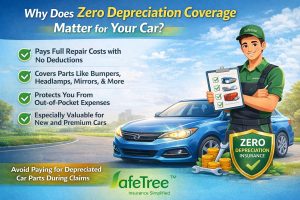
Why Does Zero Depreciation Coverage Matter for Your Car?

Whenever it comes to safeguarding your car, selecting a zero depreciation cover for your car insurance policy will be a wise move. This helps you to avoid paying for the natural wear and tear your car goes through over time. Typically, insurers deduct depreciation while setting up claims, which means you end up paying out of pocket for parts made of plastic, rubber, or fibre. With zero depreciation cover, the insurer pays the full repair cost, and no deductions are involved. When combined with a comprehensive car insurance policy, this cover offers stronger protection and greater peace of mind. Whether it’s a small scratch or major damage, your car is protected from sudden repair expenses. In the long run, zero depreciation coverage isn’t just about saving money; it’s about driving without worry.

5 years ago · by Safetree · 0 comments
GST – Impact on Motor Insurance

GST – Impact on Motor Insurance

You live in an apartment. The apartment is a part of a gated community called Society. Society needs to complete some basic tasks for every apartment, such as cleaning up the common areas, collecting garbage from each household and the common area, maintaining lights and lifts, and maintaining the building, among other activities. Who should take the responsibility to do all these things? Why should that single individual or group of individuals take that responsibility? How would such people fulfill those responsibilities?

Let us answer these questions one by one.

  1. Who should take the responsibility?

Well! The people who are living in that society should be responsible.

   2. Can every single individual be involved in such an activity?

No! Involvement of such a huge number of people would create chaos, and work would be hampered. It is why a group of people is selected to be the esteemed member of the Resident Welfare Association of society.

3. Who selects the members?

The entire resident population of the society chooses this association or team of people based on the members’ credentials, experience, and capabilities.

4. Why should the group of individuals take the additional responsibility of maintaining the society?

They should take responsibility because they are selected members of the association. They have been assigned to maintain society as the representative body of the people staying in society.

5. How would such people fulfil their responsibilities?

This team of people would appoint personnel to take care of every single activity. Certainly, they are not in a position to perform each task themselves. Therefore, they need to hire professional experts to carry out such work. While they hire professionals, they need to pay them.

6. What will be the source of funds used to pay such hired professionals?

Well! Since these are common society tasks, society needs to create a contributory fund to pay such professionals. Every single flat in society should contribute to this contributory fund to ensure society’s smooth functioning and well-being.

We are thinking of why this lengthy discussion on society and their resident welfare association? Well! Isn’t the situation somewhat similar to the country we live in? Imagine our country as a big residential society and our government to be the Resident Welfare Association. The government is the selected and elected body that performs tasks required for the well-being of the citizens (such as the creation of necessary infrastructure and providing basic amenities to the citizens). The government creates a contributory fund called TAX to perform these well-being tasks on behalf of this country’s citizens. Tax is, therefore, a contribution made by the citizens to facilitate the tasks of well-being. The government is cautious in collecting TAX from only those who can pay such TAX and uses the amount received for all the citizens (including those who do not pay taxes). It is validated by the comment of James Madison, the fourth President of the USA – “The power of taxing people and their property is essential to the very existence of government.”

The Indian Taxation System

The Indian taxation system can be classified under the following two broad headings:

  • Direct Taxes
  • Indirect Taxes

Direct taxes are easy to understand and collect. Direct taxes indicate that people are directly taxed for their income, assets, and properties. Why should they be taxed for their income? Well! People use national property such as roads, electricity, and water, among other infrastructure, to earn their income. Therefore, they should pay such taxes to facilitate the maintenance of these infrastructures. Income Tax and property tax are examples of direct taxes paid by individual residents or households.

Indirect taxes are taxes claimed by the government upon the facilities, goods, and services that the citizens use regularly. Why should people pay indirect taxes? Well! Citizens need to pay such taxes because the creation and transportation of such facilities, goods, and services use public infrastructure. Several indirect taxes were collected by the government until recently, such as the Central Sales Tax, the Central Excise Duty, and many others. At times, the indirect taxes were taxed (since there was a differentiation of taxes collected at the central and state levels). The entire indirect taxation regime was reformed by introducing a common taxation scheme called the Goods and Services Tax (GST).

What is GST?

GST, or Goods and Services Tax, is a comprehensive taxation system covering indirect taxation of the manufacture, sale, and consumption of all goods and services. With the implementation of GST, indirect taxation has become easy to understand, comprehend, and collect from the citizens on a national level (because fixed-rate slabs (0%, 5%, 12%, and 18%) of GST have been defined for all the goods and services depending on the nature of the goods and services and their utility among citizens). GST has replaced all other indirect taxes, especially taxes levied on goods and services by both the Central and State Governments. GST is further classified under the following three heads:

  • CGST: GST collected by the Centre
  • SGST: GST collected by the state
  • IGST: Interstate Goods and Services Transaction Tax

Since July 1, 2017, GST has been implemented on the manufacture, sale, and consumption of all goods and services within India’s territory. Insurance is an essential service availed by Indian citizens. Classified as a service, insurance also falls under the ambit of GST. Thus, all insurance types, including insurance of motor vehicles, attract indirect taxation under the GST. Therefore, customers purchasing insurance from insurance companies require paying the indirect tax called GST that is usually collected as a percentage of the premium paid.

Impact of GST on Motor Insurance

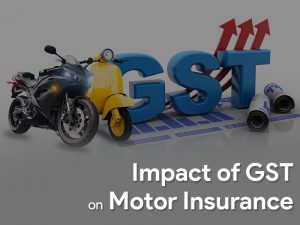
Before implementing GST, Motor Insurance was subjected to service tax, as insurance is a service provided for the benefit of India’s citizens. Implementation of GST has abolished the service tax system. Since insurance, including motor insurance, is a kind of premium service availed by the privileged citizens of India (motor insurance is availed by privileged citizens owning vehicles), the GST rate that is levied on insurance purchasers falls under the higher GST tax rate of 18%. Incidentally, this is around 3% higher than the rate of service tax (motor vehicle insurance charged 15% service tax) that was levied upon the individual insurance purchasers. Therefore, GST’s implementation has made motor insurance a little expensive compared to the pre-GST era. The 18% GST is charged on the individuals’ premium towards insuring their motor vehicles (includes both four-wheelers and two-wheelers) and on any rider premiums paid for availing any insurance rider by the individuals.

5 years ago · by Sanidhya Kain · 0 comments
Car Insurance Policy

Points to consider before buying Car Insurance Policy

Owning a car is a dream come true for most of us. With easy-to-get car loans, it is no longer difficult getting the four-wheeler of your choice home. After the initial year of car ownership, you need to make sure that you renew your car insurance. It is one of the mandatory documents required when your car is on the road. We all understand why insurance is essential because it is the best way to save your vehicle from unexpected accidents, theft, or even calamities.

Car insurance in India is required to be purchased from a third-party insurance provider. As a car owner, you have the choice to buy a one-year car insurance policy, as well as a long-term comprehensive car insurance policy.

What is a long-term comprehensive car insurance policy?

The Supreme Court of India passed a directive on September 1, 2018, regarding this. If you have purchased a car after September 1, 2018, you are entitled to buy the long-term comprehensive car insurance policy. You have two options to choose from –

  1. 1-year own damage plus 3-years third party; and
  2. 3 years own damage plus 3 years third party.

Benefits of the long-term comprehensive motor insurance policy

  • Convenience – The hassle of annual renewal can be painstaking. You can avoid it smartly by choosing to buy the long-term comprehensive policy.
  • Price advantage – by buying now, you will be paying for a three-year policy at the current rate. This means to say, at the present price, you will get your car insured for the coming three years. As it is common knowledge that insurance companies invariably raise the policy pricing annually, you are shielded from the price hike.

Thus, buying a long-term comprehensive car insurance policy is the ideal way to drive your car hassle-free and stress-free.

Points to consider before buying a long-term motor insurance policy

Getting your car insured is definitely a wise decision. Choosing to buy a long-term comprehensive plan is being smarter. However, you do need to consider certain points meticulously before deciding if this is actually the right investment at the moment for you or not.

The factors that need to be considered are:

1. Understanding if the vehicle is going to be subjected to high risk or not

If your car needs to be driven regularly through areas that are earmarked as high-risk zones for accidents or thefts, you should certainly go in for the long-term comprehensive plan. However, if the car is generally parked in the garage or is occasionally taken out, you might settle for the one-year policy because the long-term comprehensive plan is going to block your money.

2. Are you planning to sell the car in the near future?

If you are, then you need to consider the fact of the matter before buying a long-term comprehensive plan. When you sell your car, you need to transfer the insurance policy to the buyer of the car. This means that the new owner will be the holder of the motor insurance policy henceforth. Even if he pays you, remember that when you buy a new car, you will have to take out a new car insurance policy. This means that you are spending twice while getting paid once. If you have plans to sell off the old car now or in the near future, then it is recommended that you should go in for a one-year insurance policy rather than the long-term comprehensive coverage. Only when you are sure that the vehicle is going to be there with you through the next three years, go in for the long-term comprehensive plan.

3. Consider the add-ons before investing

When you buy an insurance policy, you get to select add-ons that increase the premium amount. There are add-ons like roadside assistance or engine protection. Your choice of the added facility should be based on facts and future planning. For example, if you are someone who drives out of town quite frequently, you should look at adding the roadside assistance feature to the policy. Similarly, if you have taken a Rider feature because you have a colleague or a friend travelling with you every day, you need to consider it futuristically so that the payment that you make today should be truly utilised in the later years. In this example, if there is any chance of shifting your job or your friend leaving town, you must reconsider this added feature.

4. Voluntary deductibles versus Compulsory deductibles

Compulsory deductibles are specific and predetermined; voluntary deductibles are adjustable. When you choose the first type, your premium payment will be high, and accordingly, during the claim process, there are higher chances of getting better payouts. If you choose voluntary deductibles, the premium amount is comparatively less, but the payout during the claim process is also going to be lesser.

5. Considering the services being offered by the insurance company

This is one of the most important aspects which needs to be considered when buying any type of motor insurance. Factors to consider include the reputation of the insurance provider, and it is the claim settlement process that to a great extent determines if you should choose the insurance company or not. The provider that offers a hassle-free process should be your first choice. You need to read through the company profile, reviews, and testimonials of customers on the brand website as well as social media sites to get a better understanding of the credibility of the company. Then there are some insurance providers that offer a stress-free porting option – changing from one provider to another – while some providers act difficult.

6. Free value-added features

A complete study of the services being offered by each of your shortlisted insurance providers is crucial before making a decision. There are insurance companies that facilitate online interactions, while there are some that do not. There are few that offer free pick-up from the accident spot or your home, whereas some charge and some do not offer any such service. Your requirement needs to match with the services being offered by the company for the correct decision.

Conclusion 

Use the digital medium to make well-informed decisions when considering buying a long-term comprehensive motor insurance policy.