
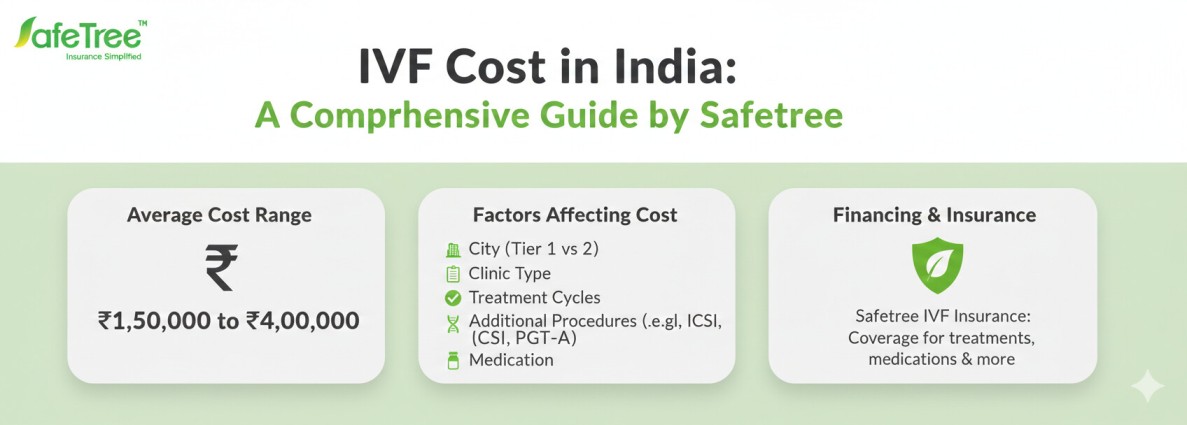
IVF Cost in India: A Financial Primer
Introduction
In India, IVF (in vitro fertilisation) is an important treatment and yet a costly path to the parenthood journey. A recent study shows that the financial burden is staggering; the average cost per IVF cycle is about ₹2.3 lakh in private clinics or hospitals and ₹1.1 lakh in government hospitals. Nearly 90% of IVF patients face catastrophic health spending, often borrowing money or depleting savings.
Typically, most of the standard health insurance plans exclude IVF, considering it an elective procedure, so couples typically pay these costs themselves. Only a tiny fraction (~5%) of couples have any IVF-specific coverage. These figures underline why the cost of IVF in India is often described as a public health crisis; the high “cost of IVF in India” means many delay or forego treatment due to financial burden.
Breaking Down the Real Cost of IVF
The real IVF treatment cost includes multiple components. A single IVF cycle typically involves:
- Consultation & testing: Initial fertility workup (scans, blood tests) may run ₹10,000–₹30,000
- Medications: Hormonal injections to stimulate the ovaries cost roughly ₹20,000–₹60,000 per cycle.
- Procedure fees: Egg retrieval, fertilisation, and embryo transfer together often cost ₹60,000–₹150,000.
- Extras: Add-on procedures (ICSI, PGT genetic tests, and embryo freezing) can add tens of thousands more.
- Total cycle cost: In sum, one IVF cycle usually runs ₹1.2–2.0 lakh (and can exceed ₹2–3 lakh with complications).
Moreover, IVF often requires multiple cycles. Medical guidelines and studies note that couples often need 2–3 cycles to achieve a positive pregnancy. Each additional cycle roughly repeats the above costs. In other words, without the insurance coverage, a couple may face repeated bills of ₹1–2 lakh for each IVF cycle, compounding stress. (For perspective, one study calculated that three IVF cycles could push a couple’s total expenses above ₹3 lakh. These outlays on treatments, tests, drugs and travel quickly add up, which is why about half of couples end up financing a loan to afford IVF.
The Role of IVF Insurance
Traditional health insurance policies in India rarely cover IVF treatment costs. However, specialised fertility insurance plans have emerged. For example, SafeTree offers dedicated IVF insurance plans tailored for Indians. These include Prime Care, Future Fertility Plan and Elite Care. Each plan comes with different waiting periods and coverages. For instance,
-
- SafeTree’s Prime Care Plan – (1‑year waiting period) provides a sum insured of ₹4.5 lakh, covering one full IVF cycle (up to ₹1.5 lakh).
- SafeTree Future Fertility Plan – (3‑year wait) offers a ₹2.5 lakh sum insured, including one IVF cycle up to ₹1.5 lakh.
- SafeTree Elite Plan – (2‑year wait) extends cover to two IVF cycles (plus IUI) up to ₹2.5 lakh in total
These insurance plans handle major IVF expenses, which include doctor fees, egg retrieval, embryo transfer, etc., within their sum insured. Some treatments (like donor gametes or advanced genetic tests) may be excluded, but core costs are insured. By contrast, without IVF insurance, couples bear 100% of infertility treatment costs out-of-pocket. For example, if a cycle costs ₹2 lakh and the insurance policy covers ₹1.5 lakh of it, the uninsured couple pays the full ₹2 lakh directly. With insurance, most of the full ₹2 lakh is covered by the policy, so the couple’s immediate bill drops drastically (they pay only the uncovered portion plus the annual premium). In sum, IVF insurance transforms unpredictable, one-off bills into manageable premiums and co-pays, significantly lowering financial risk.
IVF with Insurance: Lowering the Financial Stress
Insurance shifts IVF from a draining bill shock to a predictable cost. Health experts note that having coverage allows couples to focus on treatment rather than financial burden. IVF is not only physically and emotionally demanding, but it can also be mentally taxing if finances are tight. With insurance, many major expenses, like stimulation drugs, consultations, and procedure fees, are prepaid by the policy.
Is IVF Insurance Worth It?
For many couples, the insurance protection is worth the cost. Consider SafeTree’s plans: the Platinum Plan covers ₹1.5 lakh per cycle for about ₹9,600/year (20% co-pay applies). Without insurance, paying even one ₹1.5 lakh IVF bill at once can exhaust a year’s savings. Over multiple years, the total premium is often far less than one cycle’s fee. Similarly, Prime Care covers more (₹4.5L sum insured) at a higher premium (~₹48,773/year), which may suit those confident in using IVF soon. In all cases, the insurance premium is a small fraction of potential IVF costs. Importantly, experts recommend budgeting IVF over three cycles (as many couples need three attempts). Insurance can cover at least one or more cycles within its limits, whereas paying unguided might cut off treatment after the first unaffordable attempt.
Drawbacks: No plan covers every rupee. Waiting periods (1–3 years) mean insurance kicks in only if you haven’t started treatment immediately. Also, couples must continue paying premiums every year before claims. However, since most infertility treatments are elective and high-cost, even partial insurance greatly reduces financial exposure.
Frequently Asked Questions
What is the average IVF cost per cycle in India?
IVF in India typically ranges from about ₹1.2 lakh to ₹2.5 lakh per cycle. Basic treatment is often around ₹1–2 lakh, but costs can climb above ₹2 lakh with extra procedures or higher-priced clinics. Medication costs alone run ₹20k–60k. Because expenses vary widely by provider and medical need, budgeting should account for the higher end of these ranges.
Why is IVF so expensive?
IVF involves many complex, high-tech steps (hormone injections, egg retrieval surgery, lab fertilisation and monitoring) performed by specialists. Drugs and lab fees (for fertilising and culturing embryos) are major contributors. Each phase, which includes stimulation, monitoring scans, egg collection, and embryo transfer, incurs separate costs. If multiple eggs are fertilised and frozen, freezing/storage fees add up too. Success is not guaranteed, so multiple cycles multiply the expense. All these factors make the cost of IVF in India quite expensive.
Does standard health insurance cover IVF?
Generally no, conventional health plans consider IVF an elective procedure, so they exclude IVF and related fertility treatments. A handful of group or employer plans may offer fertility riders, but these are rare in India. As a result, most couples pay fully out of pocket. However, some insurers now offer dedicated fertility or IVF add-ons. In essence, if you have no special plan, IVF treatment cost falls entirely on you.
What does SafeTree IVF insurance cover?
SafeTree (an IRDAI-licensed broker) partners with insurers to offer three IVF insurance plans: Prime, Elite, and Platinum. These plans cover key IVF costs up to a set sum insured.
Is IVF with insurance really cheaper?
IVF with insurance converts a huge one-time expense into a more manageable ongoing cost. This means you can pursue the needed cycles without exhausting your finances at once. As one insurer explains, having IVF coverage makes treatment more accessible and really makes a difference by allowing you to concentrate on your treatment instead of stressing over bills.
How many IVF cycles does insurance cover?
Most IVF insurance plans cover a limited number of cycles, usually one or two, depending on the policy terms and sum insured. If additional IVF attempts are needed beyond the covered limit, the extra cycles must typically be paid for out of pocket or through a new policy.
Disclaimer: The cost mentioned in this article is an approximate estimate for informational purposes only. Actual treatment costs may vary depending on the hospital, location, and medical condition. Please consult a qualified healthcare professional for accurate medical advice and cost details.
Published by: A2V Insurance Brokers Pvt. Ltd. (SafeTree)





Share this post:
Facebook Twitter LinkedIn WhatsApp