Real Impact. Real Confidence.
Securing India. Together.

India has quietly crossed a crucial demographic threshold. The latest UNFPA State of World Population report puts our Total Fertility Rate (TFR) at 1.9, which is below the replacement level of 2.1.
This shift could, over time, impact our workforce, put pressure on social security systems, and slow economic momentum.
Yet, this is not a story of decline; it’s a call to collective action.
Assisted reproduction, particularly IVF, can give millions of couples the opportunity to build the families they dream of. But success requires a strong and supportive ecosystem:
🔹 Clinics that deliver world-class, ethical care
🔹 Insurers who cushion financial risk and widen access
🔹 Policymakers who streamline regulation and encourage innovation
🔹 A society that normalizes conversations around fertility and parenthood
At SafeTree, we’re committed to playing our part in designing affordable insurance solutions that make IVF financially feasible for both patients and providers.
Let’s work together so that the choice to become parents is guided by possibility, not affordability.
UN Report
According to the latest UNFPA report, India’s Total Fertility Rate (TFR) has declined to 1.9, below the replacement level of 2.1.
In 1960, Indian women had nearly 5 children on average — today it’s just 1.9.
Even though India has the largest population today, its fertility rate is now lower than the U.S. and far below many developing nations.

| Factor | India | Other Countries |
|---|---|---|
| Internal TFR Variation | High (1.4–2.9 across states) | Low or uniform |
| Age Structure | Young (median ~28 yrs) | Older (Japan: ~48 yrs) |
| Fertility Challenges | Social + medical (infertility) | Mostly social/economic |
| Marriage Trends | Mix of early & delayed | Largely delayed (urbanized) |

Delhi, Kerala, Tamil Nadu – TFR: 1.4 to 1.6 (similar to European countries)
Bihar & Uttar Pradesh – TFR: 2.8 and 2.4, respectively
This overall decline in the Total Fertility Rate (TFR) is accompanied by increasing urbanisation and a rise in per capita GDP—a global pattern also evident across Indian states. Metropolitan cities like Delhi exhibit significantly lower TFRs. This trend can be attributed to the following seven factors.
Financial Insecurity
Career Priorities
High Cost of Raising Children
Lack of Childcare Support
Lifestyle Changes
Late Marriages
Housing Constraints
Why it matters: Fewer working-age individuals must support a growing elderly population, increasing economic pressure on both public pensions and households.
As the workforce shrinks, economic growth can stagnate or even contract if productivity doesn’t keep pace.
Fewer young people entering the job market can lead to shortages in key sectors. In India, this could reverse rapid economic gains that originated from labour-rich demographics.
An ageing population raises demand for elderly care, while fewer births mean lower investments in schools and childcare.
Call or email our expert to Know more –
📞 Shiva Vikas Kumar – +91 9210044039
✉️ vikas.kumar@safetree.in
🌐 www.safetree.in
Oocyte (egg) donation in India is a key aspect of Assisted Reproductive Technologies (ART) and is regulated under the Assisted Reproductive Technology (Regulation) Act, 2021.
Surrogacy insurance in India has become an essential component of the surrogacy journey, ensuring financial security and compliance with legal requirements under the Surrogacy (Regulations) Act, 2021. This insurance provides comprehensive coverage to address medical, and risks associated with the surrogacy process, safeguarding the interests of both the surrogate mother and the intended parents.
Infertility affects millions of couples globally, with 28 million couples in India suffering from the issue. Since not being able to conceive can be one of the most difficult events in a couple’s life, research shows that couples dealing with reproductive issues experience significant anguish and worry.
Safetree has co-developed a number of cutting-edge insurance products in the travel, healthcare, and auto insurance sectors that were first offered in the Indian market.
Working directly with a variety of infertility market participants, we at Safetree are aware of the difficulties that might arise on the road to parenthood, particularly for couples undergoing IVF procedures. We have therefore developed a customised maternity insurance plan that is suited to the particular requirements of IVF patients. Our objective is to offer these couples a cost-effective insurance option while also giving them financial stability and peace of mind during this unique stage of their lives.
1. Normal and C-section Maternity Coverage: This product covers the expense of delivery. This covers everything up to the insured amount, including hotel rent, medical bills, and procedure costs.
2. Waiting Period: There is a six-month waiting period for this exclusive promotion.
3. Medically Necessary Complications: This plan covers medical treatment in the event of an untimely termination.
4. Oocyte Retrieval Complications: The plan will pay for hospitalisation expenses if there are complications during oocyte retrieval.
5. Cost-Effective Solution: Since infertility treatments are exceedingly costly, this strategy helps a couple control the costs associated with bringing a new family member into the world.
6. Limited Hospitalisation Benefits: Up to the sum covered, it does offer limited coverage for hospital stays during pregnancy.
7. Benefits under Section 80D: The Income Act’s Section 80D provides benefits under this scheme.
8. Options: There are two maternity coverage options available under this plan: Rs 50,000 and Rs 75,000.
1. Experts in Infertility Insurance: Safetree leads the market for a range of insurance products for the infertility sector and works with the majority of the top companies in the sector. We are aware of the market and provide the best products to meet the couple’s needs.
2. Committed Support Staff: Our staff of professionals is on hand to help you with the insurance procedure, respond to your enquiries, and offer tailored support.
3. Nationwide Network: The top health insurance provider in India, who underwrites the product, has a large network of medical professionals, making it simple to locate the appropriate care nearby.
Don’t delay! Start the process of giving your expanding family a better, worry-free future. For more information, please visit the following website.
“It’s not you or me; It’s us” Infertility significantly impacts emotional well-being, often leading to a complex display of emotions for both individuals and couples.
Infertility is growing across the globe including India. WHO estimates that infertility impacts a staggering 1 in 6 people worldwide, which is approximately 17% of the global population.
Insurance providers may offer coverage for female donors in ART procedures, such as IVF, for several reasons. The egg donation process can be invasive, requiring medical treatment and monitoring, which can be expensive. Furthermore, there are risks associated with egg donation, such as ovarian hyperstimulation syndrome (OHSS), which can also be costly to treat.
The fertility service sector in India is booming with an estimated 27 million infertile couples. The sector is worth thousands of crores. News reports have raised legal concerns over custody of children born to couples from abroad. Deaths of egg donors and ethical issues have also emerged. Parliament passed the Assisted Reproductive Technology (Regulation) Bill 2021 and the Surrogacy (Regulation) Bill 2020.

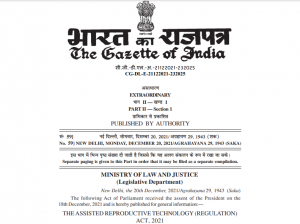
The Parliament passed the ART Act and Surrogacy Act in December 2021, and the law came into force in January 2022.
ART techniques involve manipulating sperm or egg cells outside the human body and transferring the resulting embryo into a woman’s reproductive tract. These techniques include in vitro fertilisation (IVF), sperm donation, and gestational surrogacy, where a surrogate carries a child not biologically related to her.
Every ART clinic and bank must register and maintain their details in a central database, as required by the National ART & Surrogacy Department of India. The registration is valid for five years, renewable for another five years, and can be cancelled or suspended if the institution violates the Act’s provisions. ART clinics are also prohibited from providing a child of predetermined sex, and they must conduct genetic disease checks before implanting an embryo into a woman’s reproductive tract.
According to the Act, a registered ART bank can collect, screen, and store sperm from men aged 21-55 years and store eggs from women aged 23-35 years. However, there are limitations, such as the Act only permits a woman to donate seven eggs once in her life, and the bank cannot supply the semen of one donor to more than one couple. In addition, both the donor and the couple seeking the ART procedures must provide written informed consent. The couple must also provide health and life insurance coverage for the female donor.
The Surrogacy Act expects the National and State Boards to regulate Assisted Reproductive Technology (ART) services. These boards are responsible for advising the government on policy, reviewing and monitoring the implementation of the law, and formulating a code of conduct for all ART clinics and banks.
The Act considers abandoning or exploiting children born through the ART process, the sale, purchase, or trade of the embryos, and exploiting the couple or donor in any form as offences. The first-time offenders may attract a fine of Rs 5 to 10 lakhs. Subsequent offences are punishable with imprisonment for 8 to 12 years and a fine of Rs 10 to 20 lakhs. These regulations will enhance and regulate the delivery of infertility services in India.